Search behavior has fundamentally shifted. While traditional Google searches still drive the vast majority of website visits, a new hybrid ecosystem has emerged. Google reports that AI Overviews now reaches more than 2.5 billion monthly users and AI Mode has passed 1 billion monthly users, while many consumers also turn to Google Maps and conversational AI assistants like ChatGPT, Perplexity, and Claude to find local services. For small business owners who simply want more leads and clients, the explosion of new industry acronyms can feel overwhelming.
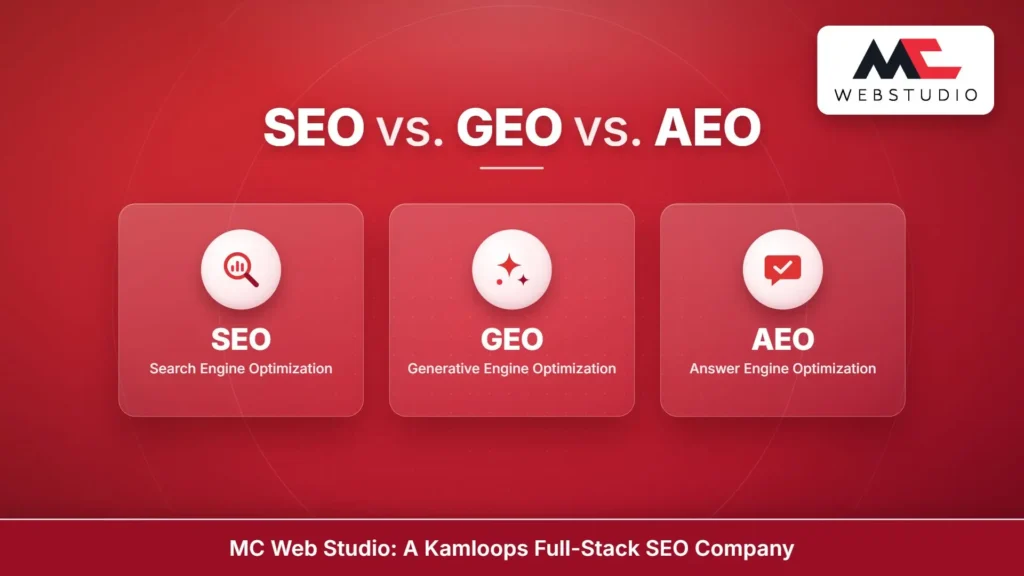
Despite the noise, authoritative data shows that Search Engine Optimization (SEO), Answer Engine Optimization (AEO), and Generative Engine Optimization (GEO) are not competing strategies. Together, AEO and GEO make up what is commonly called AI SEO, working alongside traditional SEO rather than replacing it. They are three distinct ways potential customers find your business, and they all draw from the exact same digital foundation. By optimizing your website with clear facts and a strong local reputation, you can succeed across every search platform.
Key Takeaways: SEO Vs. GEO Vs. AEO
Understand the acronyms: SEO targets traditional Google clicks and Maps rankings. AEO structures content so search engines can lift direct answers into AI Overviews and featured snippets. GEO focuses on earning recommendations inside AI chatbots like ChatGPT and Perplexity
Shared foundation: All three strategies rely on a fast, crawlable WordPress website, transparent pricing and service details, a logical heading hierarchy, and consistent local reputation signals.
No need to start over: Small business SEO does not require abandoning what currently works. Google Search Central documentation explicitly confirms that optimizing for generative AI is still fundamentally SEO.
Local reviews remain critical: Because AI models synthesize data from across the web, building a multi-platform review presence ensures your business is recommended even when AI tools cannot access Google’s walled review garden.
SEO vs. GEO vs. AEO Explained
For a small business owner, these three terms represent three different surfaces where customers look for businesses: traditional search (SEO) and the two sides of AI SEO (AEO and GEO). Understanding the mechanics of each helps clarify why they work together seamlessly.
SEO (Search Engine Optimization): This is the process of optimizing both your website and your content so your business ranks high in traditional search results. The goal is to capture top placement in Google’s organic blue links and the Google Maps Local Pack to drive steady clicks, calls, and form submissions. It covers four core types of SEO:
On-page SEO: Optimizing your service pages, headings, and helpful content so they clearly match what customers are searching for.
Off-page SEO: Building authority outside your website through credible backlinks, third-party brand mentions, and online reviews.
Local SEO: Strengthening your Google Business Profile, keeping local directory citations consistent, and reinforcing geographic relevance for nearby searches.
Technical SEO: Ensuring fast load times, mobile usability, clean code, and full crawlability so search engines can easily index your site.
AEO (Answer Engine Optimization): This focuses on formatting your pages so that search features and answer engines can easily extract a crisp, direct answer to a specific customer question. This applies to Google AI Overviews, Featured Snippets, People Also Ask boxes, and voice assistants. For example, if a user asks about local appointment availability, AEO ensures your website provides an immediate yes or no answer followed by helpful context.
GEO (Generative Engine Optimization): Formalized by researchers from Princeton University and other institutions, GEO focuses on earning citations inside generative AI engines like ChatGPT, Perplexity, Google Gemini, and Claude. These platforms use Retrieval-Augmented Generation (RAG) to pull facts from multiple websites and synthesize a recommendation. Adding clear citations, verifiable statistics, and concrete facts can improve visibility in generative engine responses by up to 40 percent.
|
Dimension |
SEO (Search Engine Optimization) |
AEO (Answer Engine Optimization) |
GEO (Generative Engine Optimization) |
|---|---|---|---|
|
Target Platforms |
Google Search (classic blue links), Bing, Google Maps / Local Pack |
Google AI Overviews, Featured Snippets, People Also Ask, voice assistants (Siri, Alexa) |
ChatGPT, Perplexity, Google Gemini, Google AI Mode, Claude, Microsoft Copilot |
|
How It Works |
Crawlers index pages and rank them based on relevance, technical health, local proximity, links, and helpful content |
Answer engines scan well-structured headings, concise Q&A blocks, tables, and schema to lift a direct answer |
Generative models use Retrieval-Augmented Generation (RAG) and query fan-out to pull facts from multiple websites, directories, and reviews |
|
Primary Focus |
On-page content and service pages, off-page authority (backlinks and reviews), local SEO (Google Business Profile and citations), and technical health (site speed and mobile usability) |
Question-based headings, immediate direct answers (yes/no + specifics), FAQ sections, transparent policies |
Verifiable facts (pricing, service scope, credentials), consistent entity details across the web, credible third-party mentions & recent reviews |
|
What Winning Looks Like |
Top-3 Google Maps Pack placement and Page 1 organic rankings driving steady clicks, calls, and form leads |
Your clinic or business is quoted verbatim in the answer box or cited beside Google’s AI summary |
Your business is named in the short list of 2-4 recommended local providers with an accurate description and clickable source link |
Where SEO, GEO, and AEO Overlap
Google’s official documentation explicitly states that optimizing for generative AI features is still fundamentally SEO and remains rooted in core Search ranking systems. AI search optimization is not about tricks; it is about providing clear, structured data. For a small business, a well-built foundation powers SEO, AEO, and GEO simultaneously.
Fast, Clean WordPress Architecture
Pages must load quickly on mobile devices, where 73 percent of local searches start. Your website must return clean HTML without hiding core service text behind heavy JavaScript or bloated page builders. Ensure your site remains fully crawlable, since Google only cites pages in AI features that are indexed and eligible to appear in Search with a snippet. If your current setup is rigid or broken, understanding redesign costs to modernize a site is a practical first step to fixing visibility.
Logical Heading Hierarchy
A clear structure using descriptive headings (H1, H2, H3) lets Google’s ranking systems and AI extractors parse what a page covers without guessing. Leading each section with a clear, direct answer before adding nuance helps capture AI snippets and RAG citations.
Transparent Service & Pricing Pages
Vague brochure copy like “contact us for a quote” gives AI models nothing concrete to extract. Publishing plain-English service descriptions, appointment lengths, exact pricing, policies, and accepted payment terms gives search engines and AI assistants verifiable facts they can confidently repeat.
Clean Structured Data (JSON-LD Schema)
Structured data must accurately match your visible on-page content. For small business websites, essential schema types include LocalBusiness, Organization, Service, and FAQPage. Managing this through a single source of truth ensures your code remains unambiguous for machine reading.
Google Business Profile (GBP) Accuracy
Consistent Name, Address, and Phone (NAP) details, accurate categories, service lists, and operating hours across Google Business Profile, Apple Maps, Bing Places, and Canadian directories feed both Google Maps and AI recommendation engines.
Local Authority and Reviews
AI search tools often cannot see inside closed review ecosystems. If your reputation only exists on Google, you may be invisible to the millions of people using ChatGPT to find local services. Earning steady, recent reviews across multiple platforms corroborates your website’s claims and helps you in showing up across Google and AI platforms consistently.
Why Platform Shifts Do Not Break This Strategy
A major anxiety for business owners is investing in a strategy only to see Google or OpenAI change their layouts next month. Research confirms that AI search surfaces are inherently more volatile than classic organic rankings. When identically prompted, generative AI tools rarely return the exact same brand list twice.
Search engines continuously tune the mix of AI summaries versus classic links. Google explicitly notes that AI Overviews are only shown when their systems determine it is additive to classic Search. Authoritas found that a high percentage of Google AI Overview cited URLs change within two to three months, and Ahrefs noted that three in four citation drops are temporary.
This volatility is precisely why chasing fragile hacks built for a single AI widget is a bad idea. Platform shifts do not break this strategy because the underlying retrieval index and trust signals remain the same. Investing in a fast WordPress site, transparent pricing, clean structured data, accurate local listings, and genuine customer reviews protects visibility whether a buyer clicks a classic Google link, scans an AI Overview, or asks ChatGPT for a local shortlist.
Real-World Example: What Good AI SEO Looks Like on Kalicube
Most business websites rely on vague slogans and bury proof of their expertise across disconnected pages. Kalicube, a digital brand engineering consultancy founded by Jason Barnard, does the exact opposite. Its website gives Google Search, AI Overviews, ChatGPT, and Perplexity clean, structured, verifiable facts that algorithms can extract and cite with zero guesswork.
Verifiable Entity Facts and Named Proof Points
Right on its homepage and About page, Kalicube anchors its brand identity with concrete, machine-readable facts: founded in 2015, tracking 25 billion data points across 73 million brands, with 17 patent applications. Instead of generic claims like “trusted by leading brands,” Kalicube names specific clients and engagements verbatim (including Ahrefs, Semrush, Yoast, Wix, and 1-800-GOT-JUNK?) alongside attributed quotes from recognized industry figures such as Joost de Valk (Yoast) and Barry Schwartz (Search Engine Land). Specific numbers and named associations give AI systems verifiable proof they can cite confidently.
Connected Entity Home and Multi-Platform Corroboration
Kalicube treats its own website as an “Entity Home” (the central source of truth for who the company is, what it does, and who it serves) and reinforces those exact same details across external profiles, press mentions, directories, and third-party reviews (including a 4.4/5 Trustpilot rating). Because search engines, knowledge graphs, and large language models cross-check facts across multiple sources, this consistent footprint helps Kalicube show up accurately across Google Search, ChatGPT, Perplexity, and Gemini.
Answer-First Definitions and Question-Led Pages
Across its site, Kalicube formats pages so answer engines and generative models can lift crisp answers without guessing:
Its homepage lists exact customer pain points in plain language, such as “AI gets my facts wrong, or out of date” and “AI confuses me with someone else.”
Dedicated entity pages (such as Entity Home and Generative Engine Optimization) open immediately with a concise “Factual definition” block before expanding into Kalicube’s perspective.
Service FAQ pages break complex questions into scannable “Your problem,” “Kalicube’s action,” and “The outcome for you” sections.
This combination of a clear Entity Home, verifiable proof points, and answer-first formatting feeds traditional Google rankings, earns AI Overview summaries, and gives generative models clean factual statements to recommend without hallucinating.
Common Mistakes to Avoid with SEO, GEO, and AEO
As small businesses adapt to AI search, a few recurring mistakes can stall results across both Google and generative platforms:
Treating SEO, AEO, and GEO as mutually exclusive: You do not pick one approach and abandon the others. Core service pages need strong SEO fundamentals, FAQ sections need AEO formatting, and in-depth resources and entity proof points drive GEO recommendations.
Writing for algorithms instead of real customers: Keyword-stuffed pages and robotic Q&A blocks backfire. Search engines and AI models both prioritize clear, helpful content written for humans first, then enhanced with clean structure and metadata.
Ignoring content freshness: Generative AI systems favor current, accurate facts. If your service descriptions, pricing, or key resources have not been updated in years, AI tools are far less likely to cite or recommend your business.
Skipping schema markup on answer-ready pages: Adding accurate LocalBusiness, Service, and FAQPage schema takes very little time and removes ambiguity for search engines trying to extract direct answers.
Measuring success by organic traffic alone: Ahrefs research associates Google AI Overviews with a 58 percent lower click-through rate for top-ranking pages, yet lower clicks do not always mean fewer leads. A Search Engine Land analysis of 94 ecommerce sites found that visitors referred by ChatGPT convert 31 percent better than non-branded organic search visitors. Track each layer separately: rankings and leads for SEO, featured snippets and People Also Ask wins for AEO, and AI citations using Google Search Console’s Generative AI performance report alongside regular prompt checks for GEO.
Assuming top Google rankings automatically guarantee AI citations: Ranking well helps, but it is not enough on its own. An Ahrefs study found that only 37 percent of URLs cited in Google AI Overviews also ranked in the top 10 organic results for the same query. Dedicated AEO formatting and GEO authority signals still matter alongside traditional SEO.
The biggest mistake of all is doing nothing because the acronyms feel overwhelming. Start small by tightening one core service page and one FAQ section, track how rankings, snippets, and AI mentions respond, and scale what works.
Practical Buyer FAQ
How to fix my Kamloops business not showing up in ChatGPT or Google AI answers?
To fix visibility issues, you must align your website with how AI retrieval actually works. First, verify crawlability to ensure AI bots can read your plain HTML content. Second, upgrade your service and pricing pages by replacing generic text with explicit service areas, exact fee ranges, and accepted payment options. Third, implement clean JSON-LD schema (LocalBusiness, Service, and FAQPage) that matches your visible content. Fourth, tighten your Google Business Profile and local directory listings for exact consistency. Finally, build multi-platform reviews so AI models have verifiable trust signals outside of Google.
Do I need to rebuild my whole WordPress website to show up in AI search?
Usually, no. If your WordPress site is crawlable and reasonably modern, targeted upgrades are often enough. Cleaning up your heading hierarchy, adding transparent service and pricing pages, fixing schema conflicts, and improving mobile speed frequently unlock SEO, AEO, and GEO gains without a full rebuild. A total redesign only makes sense if the current build is severely slow, broken on mobile devices, or structurally rigid.
How long does it take to see results across Google, ChatGPT, and Perplexity?
Technical fixes, Google Business Profile updates, and answer-formatted FAQ improvements can start influencing AI summaries and snippets within weeks (roughly 4 to 8 weeks in industry benchmarks). However, building durable organic rankings and consistent generative AI recommendations typically takes 3 to 6 months of steady work.
Why does my business appear in ChatGPT one day and disappear the next?
AI models are probabilistic, not static ranked lists. Industry studies show that citations fluctuate day to day, with roughly three in four citation drops proving temporary. The right metric to track is your consistent presence across real customer prompts over time, alongside steady Google rankings and actual leads.
If my business ranks well on Google Maps, isn’t that enough for AI search?
It helps, but it is no longer enough on its own. Studies show that Google Maps visibility does not automatically carry over into ChatGPT or Google AI Mode recommendations. Fewer than half of traditional local leaders appear in top AI recommendations. Your website content and multi-platform reviews bridge that gap.
Best consultant to help Kamloops businesses rank on ChatGPT and Perplexity?
Neither ChatGPT nor Perplexity has a fixed 10-link ranking position. A qualified consultant measures brand mention consistency, citation accuracy, and real leads. Hiring a local AI SEO specialist means getting direct communication, faster WordPress implementation, and a unified strategy tailored to small business budgets. This is a stark contrast to generalist agencies that often rely on layered account managers and legacy keyword templates.
Who offers Generative Engine Optimization and AI search optimization in Kamloops BC?
MC Web Studio is a freelance Kamloops SEO and web design studio led by Michael Currie. The studio provides AI-informed SEO, Answer Engine Optimization (AEO), Generative Engine Optimization (GEO), local SEO, and WordPress web design specifically for small and local businesses. When you want to evaluate a hands-on AI SEO specialist versus a traditional SEO agency, look for proven grounding in core technical and local SEO rather than hype claiming secret AI shortcuts.
Before committing to any long-term retainer, small business owners need to know exactly where they currently stand. Book a free SEO and AI visibility audit at https://mcwebstudio.ca/ai-seo to see how your business appears across Google Search, Google Maps, Google AI Overviews, ChatGPT, and Perplexity.