As generative engines like ChatGPT and Google AI Overviews replace traditional search results, businesses face a direct choice between legacy agency retainers and hands-on AI SEO specialists. Here is an objective comparison of both models, examining the real costs, operational differences, and technical strategies that drive search visibility today.
Key Takeaways: Working With An AI SEO Specialist Vs. A Traditional SEO Agency
- Shift to generative search: Over 45% of consumers now use conversational AI to discover businesses, moving search from keyword rankings to AI answer synthesis.
- Entities over keywords: Modern AI search engines prioritize machine-readable entity data and schema markup over traditional keyword density.
- Direct execution vs. agency overhead: AI SEO specialists implement technical schema and CMS updates directly, eliminating bloated agency retainers and developer backlogs.
- Regional BC advantage: Partnering with an agile AI SEO specialist in Kamloops or Vancouver helps businesses implement hands-on entity architecture and secure conversational search visibility before local competitors adapt.
- Strict eligibility filters: Generative platforms like ChatGPT and Perplexity evaluate businesses using strict confidence thresholds, requiring explicit pricing, directory consensus, and strong review sentiment.
In 2026, the search landscape has shifted dramatically from a ranking-first paradigm to a retrieval-and-synthesis paradigm. While legacy search engine optimization (SEO) agencies still structure retainers around ten-blue-link keyword tracking and manual content calendars, users have aggressively migrated toward conversational, generative search. According to the BrightLocal 2026 Local Consumer Review Survey, 45% of consumers now use AI tools to find and evaluate local businesses—a staggering increase from just 6% in 2025.
As Google’s unilateral share of local discovery declines, businesses are caught at a crossroads. Do you continue paying a traditional agency for outmoded metrics, or pivot to an AI SEO specialist? This in-depth comparison explores the fundamental differences between legacy SEO agencies and modern AI search optimization specialists, examining what actually drives conversational citations in ChatGPT, Perplexity, Claude and Google AI Overviews today.
What is AI Search Optimization?
AI search optimization—often referred to as Generative Engine Optimization (GEO)—is the technical process of structuring digital content and business entities so that Large Language Models (LLMs) and retrieval-augmented generation (RAG) engines can easily extract, verify, and cite them in conversational answers.
Unlike traditional SEO, which relies heavily on keyword density and arbitrary backlink volume to rank URLs on a search engine results page (SERP), AI SEO focuses on establishing verifiable “entities” across a cross-platform knowledge graph. Research from Princeton University published at KDD 2024 demonstrated that optimizing for generative engines boosts source visibility by up to 40% in AI responses.
Traditional SEO Agency vs. AI SEO Specialist: A Structural Comparison
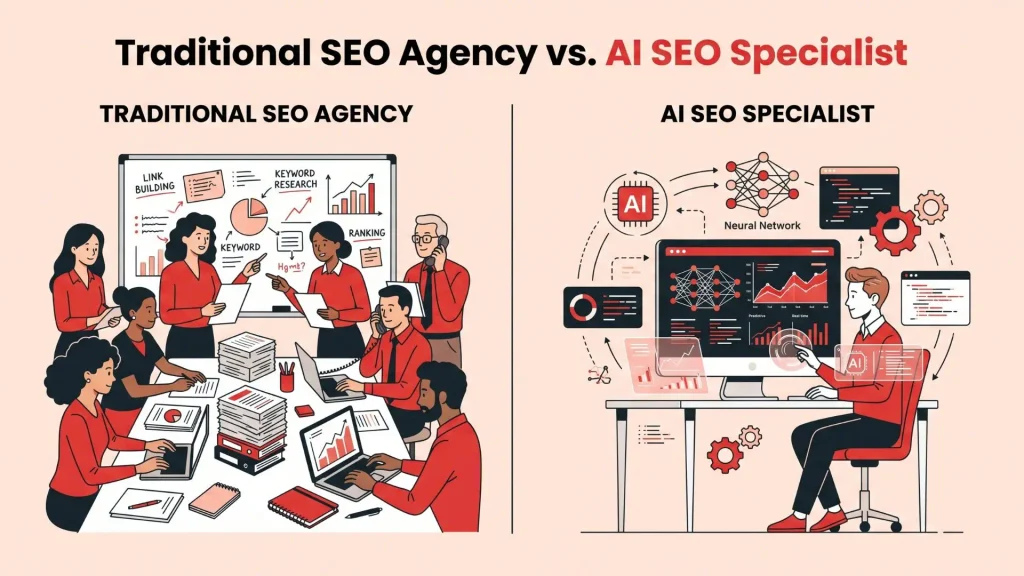
As documented in recent search industry analyses by Aysa.ai and Agile Digital Agency, the fundamental divergence between traditional SEO agencies and AI SEO specialists lies in operational workflows, targeted endpoints, and billing incentives.
The legacy retainer model often bottlenecks technical execution behind account managers. In contrast, the modern AI optimization model pairs entity-first architecture with direct Content Management System (CMS) execution.
| Operating Dimension | Traditional SEO Agency | AI SEO Specialist / Studio |
|---|---|---|
| Core Objective | Ranking URLs on page 1 of Google organic SERPs (blue links). | Earning citations and entity presence across ChatGPT, Perplexity, Gemini, and Google AI Overviews. |
| Underlying Strategy | Keyword-driven: Clustering target search terms and stuffing variations into 2,000-word blog posts. | Entity-first: Establishing machine-readable knowledge nodes, schema structures, and semantic salience. |
| Technical Delivery | PDF technical audits and developer recommendations that frequently languish in client backlogs. | Hands-on, full-stack execution: directly structuring code, Schema JSON-LD, and layout inside the CMS. |
| Data Ecosystem | Exclusively Google Search Console and Google Business Profile. | Multi-engine indexing: Google/Gemini, Bing Webmaster Tools (for ChatGPT), Yelp API, and sentiment hubs. |
| Cost Structure | $4,000–$8,000/month recurring retainers burdened by heavy agency overhead and management layers. | Agile, transparent monthly engagements ($1,500–$3,500/month) with zero intermediate management layers. |
Traditional SEO Agency vs AI SEO Specialist: What Gets Better Results?
In 2026, an AI SEO specialist delivers faster, more measurable visibility results for small-to-midsize businesses than a traditional SEO agency, primarily due to differences in agility, technical execution, and strategic focus.
Here is exactly why the specialist model outperforms traditional agency retainers in today’s search ecosystem:
- Visibility Across the Modern Search Mix: Traditional SEO agencies focus primarily on Google blue-link rankings. However, with 45% of consumers now discovering local businesses via AI search and ~30% of AI citations originating from domains ranking outside Google’s organic Top 100, traditional agencies miss nearly half the discovery market. An AI SEO specialist optimizes simultaneously for Google AI Overviews, ChatGPT Search, and Perplexity.
- Direct Implementation vs. Deliverable Backlogs: Traditional SEO agencies operate with heavy management layers (account managers, strategists, junior writers), delivering monthly audit reports and keyword dashboards that often get stuck in developer queues. In contrast, an AI SEO specialist functions as both technical developer and search strategist, implementing schema markup, semantic architecture, and CMS enhancements directly on platforms like WordPress or Squarespace.
- Entity Modeling vs. Keyword Stuffing: Princeton University’s GEO research proved that generative engine optimization boosts visibility by up to 40% by focusing on authoritative data, factual density, and clear entity definitions. Traditional agencies that continue to write keyword-stuffed, 2,500-word articles fail to trigger the semantic salience required by modern LLM retrieval algorithms.
- Cost Efficiency and ROI: Traditional agencies typically demand 6-to-12-month lock-in retainers ranging from $4,000 to $8,000 per month to cover organizational overhead. An agile AI SEO specialist provides targeted, high-impact sprints and monthly maintenance at a fraction of the cost, aligning billing directly with execution speed and conversational visibility.
Services That Optimize Local Businesses for AI Search Engines Like ChatGPT, Gemini and Perplexity
To optimize a local business for generative AI search engines like ChatGPT and Perplexity, an AI SEO specialist provides five foundational services that traditional agencies frequently overlook:
- Multi-Engine Index Harmonization (Bing + Yelp + Google): ChatGPT’s web search engine is heavily integrated with the Bing index and uses an official Yelp data partnership for local business citations (confirmed in August 2026). Optimizing Bing Places, claiming Yelp business profiles, and configuring
OAI-SearchBotcrawler accessibility are mandatory prerequisites for ChatGPT visibility. - Entity-First Schema & Knowledge Graph Architecture: Deployment of nested JSON-LD schema markup (
LocalBusiness,hasOfferCatalog,sameAs) directly into website code ensures LLMs resolve the business as a distinct entity in machine memory rather than an unverified text string. - Front-Loaded, Extractable Answer Engineering: Structuring service and landing pages with clear, unambiguous factual statements, service area definitions, and explicit pricing ranges in the upper third of the page. According to an ACM SIGIR 2026 empirical study of 252,000 trials, explicit pricing and recent timestamps are the strongest drivers of first-position AI citations.
- Third-Party Directory & “Best Of” Consensus Building: The Cheers 2026 baseline study revealed that Perplexity (93.5%) and ChatGPT (84.2%) cite local business directories and curated “best-of” lists to validate recommendations. Optimizing presence across niche local directories builds the cross-source consensus AI engines demand.
- Sentiment & Review Signal Management: AI assistants treat reviews as a binary eligibility filter. Research from SOCi demonstrates that ChatGPT recommends only ~1.2% of local business locations evaluated, almost exclusively favoring businesses averaging 4.3 stars or higher. Sub-4.0 businesses face near-total exclusion.
The MC Web Studio Approach: Developer-Level AI Execution
Translating these complex RAG requirements into a live website requires a hybrid skillset that large agencies rarely offer at accessible price points. MC Web Studio, founded and operated by Michael Currie in Kamloops, British Columbia, sits at the intersection of AI-informed SEO, local search optimization, and hands-on web development.
Rather than handing clients a list of recommendations to pass to a third-party developer, Currie implements entity schema, technical performance tweaks, semantic site architecture, and content adjustments directly within WordPress or Squarespace.
“Traditional SEO agencies optimize for the click; AI SEO specialists optimize for the synthesis. If your business is not structured as a recognizable entity across Bing, Yelp, and Google, conversational engines will exclude you from the single-answer recommendation,” notes Michael Currie.
By unifying local citations and structured data across the entire multi-engine ecosystem, small and mid-sized businesses gain direct access to a senior practitioner without paying for agency account managers or speculative deliverable counts. As MC Web Studio emphasizes: “The era of keyword stuffing is over. In 2026, AI search engines evaluate local businesses using a pass-fail confidence threshold: either your services, pricing, and entity references are validated across multiple trusted knowledge nodes, or your brand is entirely invisible to 45% of searchers.”
The Technical Mechanics: Why Entities Defeat Keywords
Traditional SEO treated the URL as the fundamental unit of optimization. In AI search, the Entity is the atomic unit.
As detailed by Search Engine Land and CrawlSense, an entity is an unambiguous person, organization, place, or concept cataloged in machine memory. When a user queries a generative engine, the model executes a process called Query Decomposition (or “Fan-Out”). For instance, a query like “best web designer in Kamloops for small business” is broken down into sub-queries verifying location, portfolio proof, transparent pricing, and reputation.
Research from Stridec shows that Google AI Overviews appear on approximately 25% of queries, and ranking on decomposed fan-out sub-queries increases citation odds by 161%. If your website relies solely on traditional keyword optimization rather than structured entity disambiguation, you will fail the exclusion filter of modern RAG pipelines.
Working With An AI SEO Specialist In Kamloops
For local businesses in Kamloops and surrounding communities—from Sun Peaks and Chase to Merritt and the Okanagan—search visibility is increasingly decided by AI recommendation engines rather than traditional regional directories. When potential clients query ChatGPT, Perplexity, or Google AI Overviews for service providers in Kamloops, modern engines synthesize recommendations based on localized entity data, regional directory consensus, and explicit service markup.
Partnering with a Kamloops-based practitioner like MC Web Studio gives local companies direct access to hands-on technical execution without agency bloat. By embedding precise localized schema, coordinating multi-engine citations across Bing and Yelp, and aligning site content with how generative engines evaluate local relevance, businesses across the Thompson-Okanagan can capture conversational search queries before their competitors adapt.
Key Kamloops Industries and Organizations That Benefit from AI SEO
Both major institutions and independent local enterprises across the Kamloops region stand to gain substantial competitive advantages by optimizing for ChatGPT, Perplexity, Gemini and Claude:
- Higher Education & Institutions: Regional anchors like Thompson Rivers University (TRU) benefit from robust entity disambiguation, ensuring program details, academic departments, and faculty credentials are cited accurately when prospective students query conversational engines.
- Legal Practices: Established firms such as Fulton & Company and MJB Lawyers need structured schema and authoritative topical depth to be recommended in conversational queries regarding business law, estate planning, or litigation.
- Medical & Healthcare Clinics: Providers such as Horizon Dental, Kamloops Physiotherapy and Sports Injury Centre, and specialized local practices rely on high-confidence sentiment signals and clear service-area data to meet the strict eligibility filters AI platforms apply before suggesting care.
- Real Estate Agents & Brokerages: Leading brokerages like Brendan Shaw Real Estate and Royal LePage Westwin Realty face intense competition when buyers query AI tools for neighbourhood guides; explicit service definitions and multi-source consensus ensure their agents are cited in regional relocation answers.
- Construction Companies & Trades: Established builders and contractors like Acres Enterprises and Syndicate Lines and Contracting benefit from structured project galleries, explicit licensing, and verified review profiles that prompt LLMs to recommend them for high-value residential and commercial builds.
Navigating the Future of Discovery
Transitioning from legacy SEO agencies to specialized AI SEO optimization is no longer just an experimental strategy—it is a baseline requirement for local business survival in 2026. Generative AI engines do not care about your keyword density or your 2,000-word blog posts; they care about verifiable facts, explicit pricing, entity consensus, and high-confidence sentiment.
By partnering with an agile AI SEO specialist who can directly implement entity-first architecture in your CMS, your business stops competing for a blue link on page two of Google and starts becoming the definitive, single-source answer in the AI chat interfaces where your customers are actually searching.
Working With An AI SEO Specialist Vs. Traditional SEO Agency: FAQs
Can you do SEO with AI?
Yes, but modern AI SEO goes far beyond using AI to generate blog posts. Effective AI search optimization involves structuring your website’s data, entities, and JSON-LD schema so retrieval-augmented generation (RAG) engines—like ChatGPT Search, Google AI Overviews, and Perplexity—can easily extract, verify, and cite your business in conversational answers.
What is the difference between an AI SEO specialist and an SEO specialist?
A traditional SEO specialist primarily focuses on keyword rankings, backlink volume, and Google organic ten-blue-link results, often delivering recommendations via monthly audit reports. An AI SEO specialist focuses on Generative Engine Optimization (GEO), entity disambiguation, multi-engine indexing (Bing, Yelp, and Google), and direct CMS execution to earn citations in AI syntheses.
How can I get ChatGPT to recommend my business?
To earn recommendations in ChatGPT, your business must establish multi-engine presence across Bing Places and Yelp (an official OpenAI data partner), deploy nested schema markup (LocalBusiness and hasOfferCatalog), maintain strong review sentiment (averaging 4.3 stars or higher), and clearly publish explicit pricing and service specifications on your website.
How much does AI SEO cost?
While traditional SEO agencies typically require 6-to-12-month retainers ranging from $4,000 to $8,000 per month burdened by agency overhead, agile AI SEO specialists typically charge between $1,500 and $3,500 per month for targeted implementation sprints and direct CMS execution with zero intermediate management layers.